
Choose one letter, read a short story that shows it, and point to the printed letter as you say its name and one sound. Then invite your child to help you find it on the page. That's the whole idea.
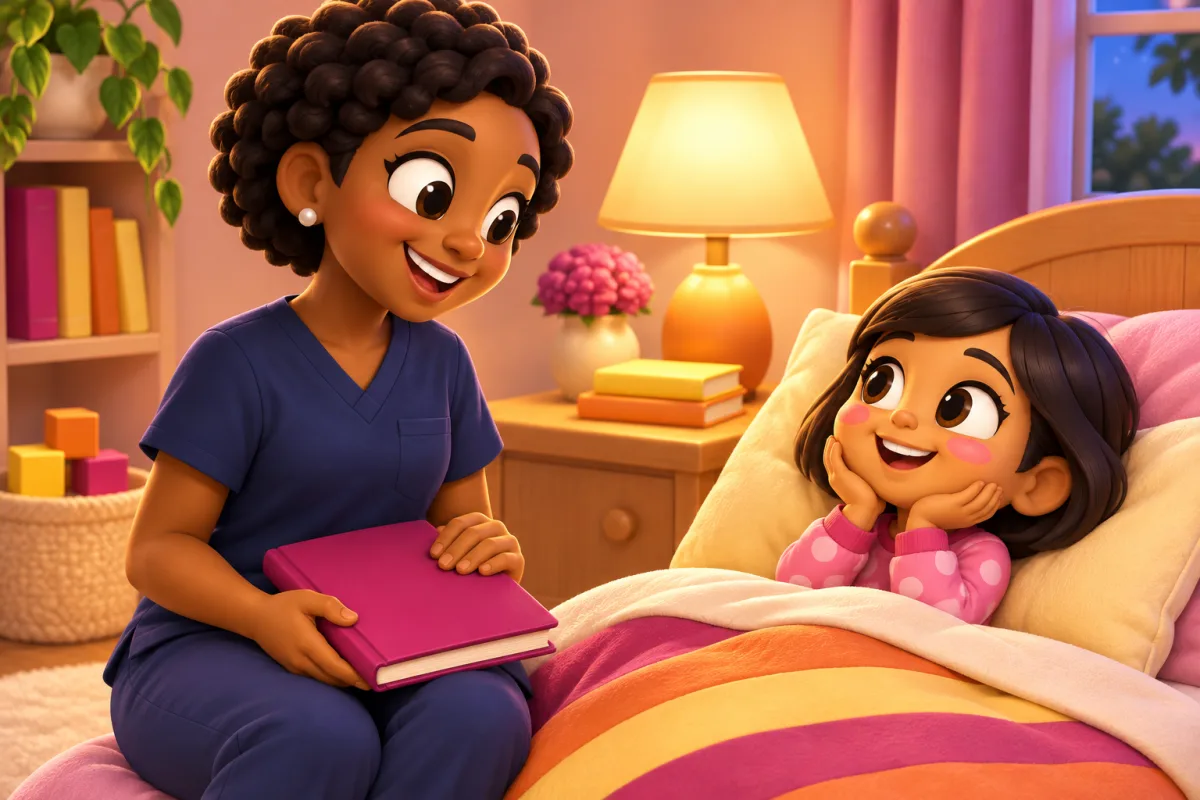
It takes about five to ten minutes, and it fits into the story you may already read at bedtime. It doesn't need flashcards, a worksheet or a special kit. It only needs you, a book, and your finger on one letter.
By the end of this article you'll have a four-step routine you can run tonight. You'll know exactly what to say, what to do if your little one only wants to listen, and how to stop while it still feels good. Nothing here is a test, and a tired evening is a fine evening to start.
The method
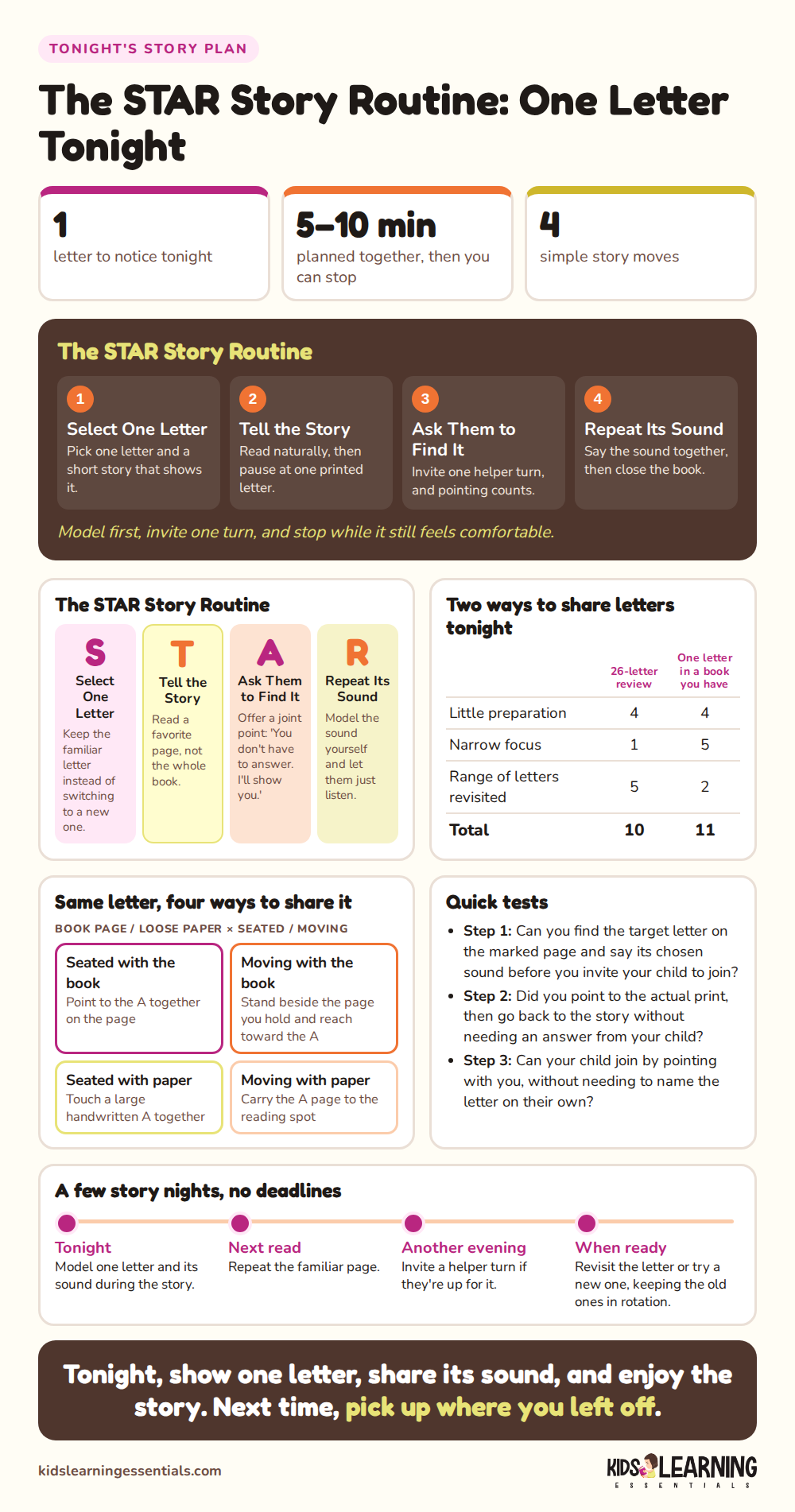
The STAR Story Routine
- 1Select One LetterPick one letter and a short story that shows it.
- 2Tell the StoryRead naturally, then pause at one printed letter.
- 3Ask Them to Find ItInvite one helper turn, and pointing counts.
- 4Repeat Its SoundSay the sound together, then close the book.
Model first, invite one turn, and stop while it still feels comfortable.
Start With One Story, One Letter, and One Sound
Why one letter is enough
One letter gives your child something to hold onto. If you point at A on Monday and A again on Tuesday, the shape starts to look familiar. Returning to A gives your child another chance to notice its shape without adding another task tonight.
One sound works the same way. A makes more than one sound, but tonight you only need one, like the short sound at the start of ant. Say it the same way each time.
One story gives the letter a home. A story has pictures, voices and a giggle or two, so the letter shows up inside something your child already enjoys. That feels very different from a drill.
What a good night looks like
Here's a real evening. You're home after a long shift, and there are about ten minutes before lights out. You read a short book. On one page, you put your finger under an A and say, "This is A. Aaa, like ant." Then you keep reading.
Your child might say "ant." They might say nothing and snuggle closer. Either one is a good night, because they just saw the letter and heard its name and sound, with you right beside them.
Know What Your Child Is Practicing
When you read a letter story, your child is practicing three different jobs. It helps to know which one you're working on, so you don't expect all three at once.
A Letter's Shape, Name, and Sound
The first job is the shape. Your child notices that this mark, A, looks different from that one, B. They don't have to say anything to practice this. Looking is enough.
The second job is the name. You say 'A,' and over many nights, that name attaches to the shape.
The third job is the sound. A is the letter, and aaa, like the start of ant, is one sound it can make. Name and sound are two separate facts about the same shape.
Pointing to print while you read ties all three together. Your child sees the shape, hears the name and hears the sound, all in one moment. That's a lot of learning for a few seconds of finger-pointing.
Here's one thing worth knowing. If your child says 'ant' when they see a picture of an ant, that shows they know the word. It doesn't yet show they know the letter the word starts with. The letter is the printed shape, so that's where your finger goes.
What if your child sings the whole alphabet song but can't find the A on the page? That's very common. Singing the song is one skill, and finding a printed shape is another. Pointing to the letter in a story is how the two start to meet.
And because these are three separate jobs, one answer from your child never tells you about all three. A point is a point. A name is a name. Take whatever shows up.
So tonight, you're not checking what your child knows. You're giving them one more chance to see a letter, hear its name and hear its sound, all together.
- Noticing printed letter shapes in a story
- Hearing a letter's name and one sound
- Joining a grown-up who shows and says it first
- Reading words on their own
- Memorizing every sound at once
- Answering a string of test questions
Choose a Short Routine Instead of a Long Review
You could do a full-alphabet review. Twenty-six letters, an alphabet book you already own, a chart on the fridge. It doesn't have to mean quizzing. You could simply share the letters together, one after another.
A one-letter story asks for a little less. You grab a book, pick one letter you can see on the page and decide on one sound. That's the whole setup.
Which one fits a tired evening
Here's how the two paths compare for a tired evening.
In the table below, the full review covers more letters, while the one-letter story keeps the focus smaller. Both can take little preparation with a book you already have.
Either path can be adapted. If you have time, energy and a reason to go through all the letters, do that. But on a tired evening, the simpler start is often the easier one to say yes to.
What if you only have an ordinary picture book?
Then you have what you need. Any short picture book works. Flip through it, find a printed letter that shows up clearly, and use that one. A title on the cover, a big letter on a page or a word in a speech bubble will do.
You don't need a special purchase to do this. Keep it simple: start with one story you already have and one letter you can see.
Compare a full 26-letter review with one letter in a book you have. Higher scores mean less preparation, a narrower focus, or more letters revisited, depending on the row.
| What matters | 26-letter review | One letter in a book you have |
|---|---|---|
| Little preparation | 4 | 4 |
| Narrow focus | 1 | 5 |
| Range of letters revisited | 5 | 2 |
| Total | 10 / 15 | 11 / 15 |
A full review is still fine on a calm day, and you never need a special purchase for either.
Step 1: Select One Letter and a Suitable Story
Start with a letter that already means something. The first letter of your child's name is the easy winner. They see it on cups, coats and drawings, so it already feels like theirs.
No obvious letter? Pick A. It's the first one, it's easy to spot on a page, and it has a clear first sound.
Use What You Already Have
Next, find a short book with that letter in it. Look for a page where the letter is large and easy to see. Mark it with a sticky note or a folded corner so you can find it fast while a sleepy child waits.
Then decide on one sound and one example word before you start. For A, use the short sound at the start of ant. You don't have to teach every sound A makes. One is plenty for tonight.
Doing this a few minutes ahead helps. You might do it on your break, or while the kettle heats. That way, when you sit down together, there's nothing to figure out.
What if your child picks a favorite book that isn't about letters at all? Read it. Most books have a few printed letters on the cover or in the first line. Choose one letter from a page and use the same plan.
You can even say, 'Let's find an A in this one.' You're borrowing a story they already love, so the letter rides along on something familiar.
If you'd like a story built around one letter, the Andy Ant eBook for the letter A is a short story you can read together on a device. It's optional, and any suitable book works just as well.
Step 2: Tell the Story Without Turning It Into a Quiz
Settle in first. Sit close, get comfortable and let your child hold the book if they want to. The story comes first, and the letter is just a small visit inside it.
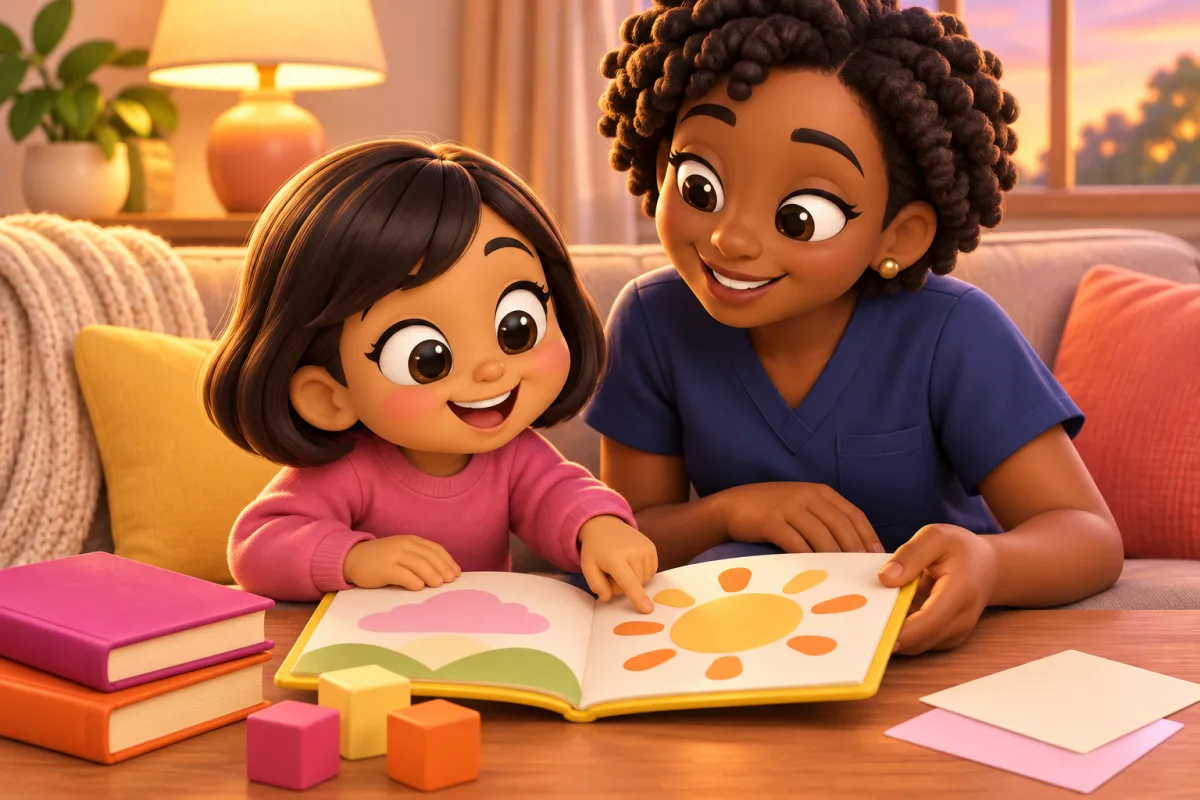
Read naturally. Use the voices. Let them laugh. If you're quizzing from page one, the story stops being a story, and a child who already worries about getting things wrong will feel it right away.
Pause at One Printed Letter
When you reach your marked page, slow down. Put your finger under one clear letter, like an A. Say, 'This is A.'
Then model the sound. Say the short vowel on its own, as in the start of ant: aaa. Keep it short and clean. Try not to add an extra 'uh' at the end of the sound.
Notice that you're saying the sound, not the letter name. The name is 'A,' like the first word you said. The sound is the quick 'aaa' at the start of ant. Keeping the two apart makes it easier for your child to hear which is which.
What your child is practicing here is connecting print with spoken language. They're learning that the marks on the page stand for sounds you can say.
Exact Words You Can Borrow
Try this: 'This is A. In ant, A spells this sound. Say ant with me.' Pause and smile.
Your child might say 'ant.' They might say 'aaa.' They might just look at you. All three are good answers.
Then go straight back to the story. Turn the page and carry on in your story voice. Don't wait for a reply, and don't circle back to check.
Here are a few more short lines you can borrow:
- 'Look, here's A again.'
- 'Aaa, like ant.'
- 'I see our letter!'
Say one of them, once, then let the story take over. Your child may add their own bit, like 'ant has six legs.' Say, 'Yes, ants do have six legs!' and enjoy it. That's a good night too.
If they interrupt, skip pages or want it again
Interruptions mean they're engaged. If they flip ahead, let them. If they ask a question about the picture, answer it. The letter can wait a page.
If they want the story again, read it again. Hearing the same story twice makes the letter more familiar. Many four-year-olds love the same book night after night, and that works in your favor.
You can always point to the A one more time. The same words work on a second read, and the same words are easier for a tired grown-up to remember.
Step 3: Ask Them to Find the Letter With You
After the story, turn back to the marked page. Show the target letter again. Say, 'Here's A.' Letting your child see it a second time helps before you ask for anything.
Then give them a small job. Kids like being the helper. It turns the moment from 'Do you know this?' into 'Will you help me?'
Make Your Child the Letter Helper
Ask one question, once: 'Can you help me point to this A?' Keep your marked A in view while you ask. That's all. You're not asking for a name or a sound, just a finger on a page.
If they point to the A with you, say, 'You found it! That's A.' If they point to something else, we'll get to that below. If they watch, that's fine too.
Say the letter name when you celebrate, so the name gets attached to the shape. 'You found A!' does a quiet bit of teaching without sounding like a lesson.
When They Point Somewhere Else
Your child might point to a picture, a different letter or the corner of the page. Don't say 'No.' Say, 'Thanks for pointing. Here's A. Let's point together.'
Then put your finger next to theirs, and touch the A together. That's still a turn, and it ends with them seeing the right letter.
If they point to a different letter, you can say, 'You found a letter! That one's B. Our letter today is A.' You've named both, and nobody lost anything.
Some kids get upset when they miss. If you see a frown, skip the question. Say, 'You don't have to find it. I'll show you,' and point to the A yourself. Then say the sound and go on.
What if they insist their pick is the one? Smile and say, 'Good looking! Let's touch the A one more time together.' Then close the page.
One helper turn is plenty.
Step 4: Repeat the Sound in One Tiny Game
Now for the last move, and it's a short one. It's a copy-me game with the sound from the story.
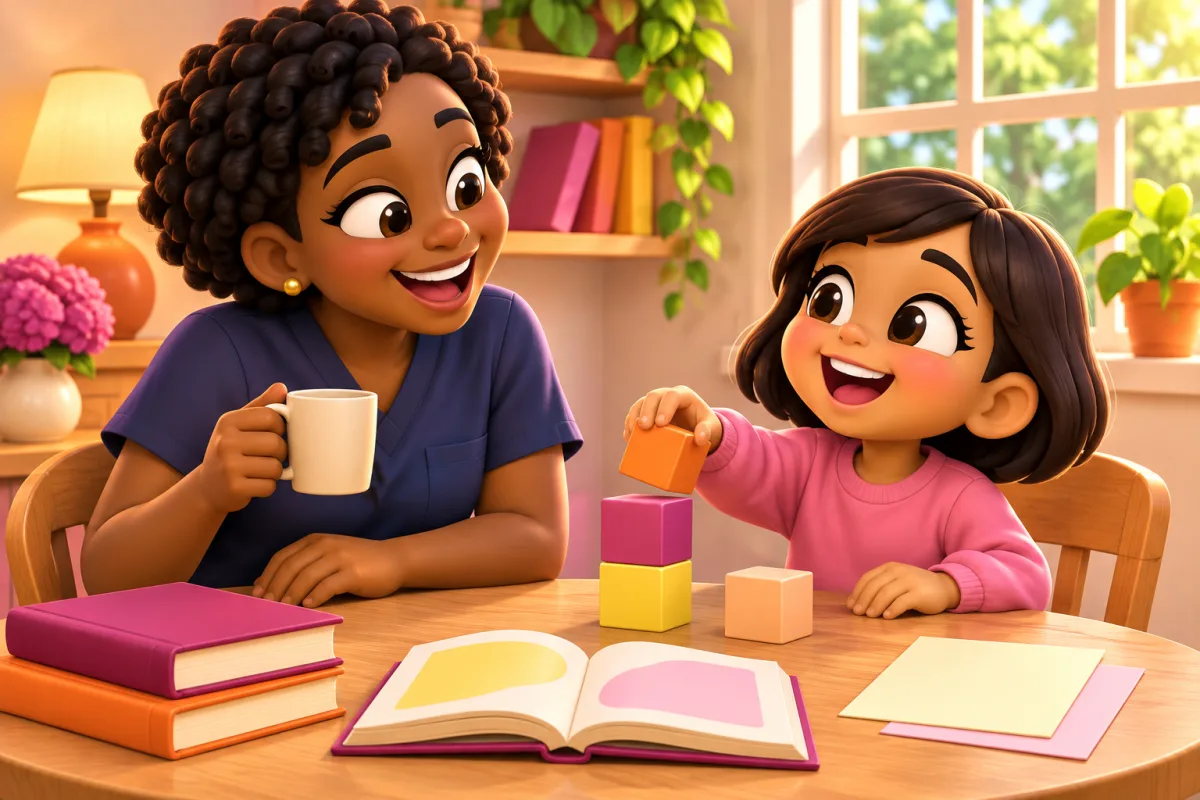
Point to the target letter. Say the sound once: 'Aaa.' Then say the story word: 'Ant.' That's the model. Your child can echo, point or just listen.
One helper turn is plenty.
Kids who love repetition tend to enjoy this part most, because they know exactly what's coming. It's the same sound and word every time.
Say It Together, Then Close the Book
Try this: 'Let's say it together. Aaa, ant.' Say it with them, so they never have to guess alone. Your voice carries the sound and theirs can ride along.
Here's how a few different children might respond, and what you can say back:
- They say 'aaa, ant!' loudly. You say, 'Aaa, ant. Yes!'
- They giggle and say something silly. You laugh and say, 'Silly ant! Aaa, ant.'
- They point to the A and stay quiet. You say, 'You're showing me A. Aaa, ant.'
- They look away. You say the sound once yourself and smile.
In every case, you end by saying the sound correctly, so the last thing your child hears is the right one. You never have to correct anything out loud.
Then you can finish. You can also repeat once if they ask for more. If they want to play again, do it. If they're done, close the book and say, 'That was a good story.'
If your child would enjoy a page to point to afterward, one of the Letter Aa coloring pages from the Andy Ant story can help. It's optional. It isn't extra required work, just something to color and point at.
What if your child doesn't repeat the sound at all? That's okay. They heard it, and they saw the letter that goes with it. You can try again another night with the same page.
What if they want to keep playing long after you're ready to stop? Say, 'One more, then we'll save the rest for tomorrow.' Do one more round, then close the book. Stopping while they still want more makes tomorrow's story easier to start.
Reset Gently When It Starts to Feel Like a Test
Sometimes the mood shifts partway through. It helps to know the signs.
Your child might turn away, go quiet, say 'I don't know' in a small voice or start to fidget. They might say, 'I can't do it.' These all mean the same thing: less questioning, please, or an earlier finish.
You may also notice it in small ways. A shorter answer than usual. A sigh. A hand pushing the book away. Trust what you see more than the plan.
Model Instead of Asking Again
The good news is that you don't need a new plan. You can use the same four moves, just led by you. Keep the letter familiar. Read a favorite page. Offer a joint point, and model the sound yourself.
Then say the one sentence that takes the pressure off: 'You don't have to answer. I'll show you.' Then show them, and keep it light.
One rough evening doesn't mean anything. Kids are tired, hungry or just done. Stop, cuddle and read for fun. The letter will still be there tomorrow.
But what if letters or sounds keep worrying you over weeks and months? Then it's worth a conversation with your child's teacher or a healthcare professional. They can look at the whole picture, and you don't have to figure it out alone. There's no deadline for knowing letters, and you aren't expected to diagnose anything.
A tired evening and an ongoing worry are different things. The first needs a softer plan. The second needs another set of eyes.
Keep the familiar letter instead of switching to a new one.
Read a favorite page, not the whole book.
Offer a joint point: 'You don't have to answer. I'll show you.'
Model the sound yourself and let them just listen.
Match Tonight's Practice to Your Child's Energy
Some nights your child wants to curl up. Other nights they can't stop wiggling. You can keep the same letter and change only how you share it.
The grid below isn't four tasks. It's four ways to do the same one thing, so pick the one that fits the moment.
Which one to use
Look at what's beside you. If you have the book, use the book. If it's a scrap of paper and a pencil, write a big A. Either works.
If your child wants quiet, stay seated and point together. Say, 'Here's A,' and touch it. That's the whole thing.
If they're wiggly, let them stand and reach toward the letter. Hold the page up and say, 'Let's find A together.' Their body gets to move, and their eyes still land on the letter. That's movement, and it still counts.
No book handy, say, at the kitchen table or in the parking lot before shift change? Write a large A on the back of an envelope. Touch it and say, 'A, like the start of ant.' A wiggly child can carry the paper to the reading spot and say, 'Bring our A to the story.'
If you're not sure, start with the seated book option. It's the easiest, and it asks the least of you.
And if even the shortest version feels like too much tonight? Skip it. Shared reading alone is a good evening. You can bring the letter back tomorrow, and the page will be right where you left it.
There's no wrong way to adjust. If the first idea doesn't fit, try another one, or let it go for the night.
- Point to the A together on the page
- Say, 'Here's A.'
- Stand beside the page you hold and reach toward the A
- Say, 'Let's find A together.'
- Touch a large handwritten A together
- Say, 'A, like the start of ant.'
- Carry the A page to the reading spot
- Say, 'Bring our A to the story.'
Pick Up Where You Left Off Tomorrow
There's no fixed schedule here. The points below show what a few story nights might look like, not deadlines your child has to meet.
Tonight, you model one letter and one sound. The next time you read, you go back to the same familiar page. On another evening, if your child likes it, you invite a helper turn. When they seem ready, you revisit the letter or try a new one.
A Simple Note for Grandma
On the nights you work, you can hand it off with a one-line note. Stick it on the book: 'We read the A story, pointed to A, and said the first sound in ant. Show it together again.'
That's all Grandma needs. She doesn't have to teach anything. Grandma just repeats what's already familiar, and your child gets the same routine from two people.
When to Try Another Letter
Try a new letter when your child seems comfortable with the first one, or when they ask for something different. Keep the familiar letters in rotation so they don't disappear.
One more thing. Letters have more sounds than the first one you chose. A makes other sounds, and you can explore those later, with no rush.
To find a story for another letter, you can look through all of the alphabet storybooks, one per letter. You don't have to buy a set or finish the alphabet by a date.
Missed several nights? Pick up where you left off. The page, the letter and the sound will all be waiting.
- TonightModel one letter and its sound during the story.
- Next readRepeat the familiar page.
- Another eveningInvite a helper turn if they're up for it.
- When readyRevisit the letter or try a new one, keeping the old ones in rotation.
Missed a few nights? Pick up where you left off.
Quick check
1. What should you do first when you reach the marked page?
Modeling first means your child sees and hears the letter before being asked for anything.
2. Your child points to a picture instead of the letter. What can you say?
You welcome what they did and then show the right letter together, so nobody feels wrong.
3. Which counts as taking part in this routine?
Listening, pointing and echoing all connect your child to the letter and its sound.
Questions parents and teachers ask
Should I introduce uppercase and lowercase letters together?
Start with whichever one you see in the book, and add the other later. Many stories show both, so you can say, 'Here's big A and here's little a.' One at a time is fine, and pairing them can come when your child seems comfortable.
Do I need to teach letters in alphabetical order?
No, you can start anywhere. The first letter of your child's name is often a great choice because it already means something to them. Alphabetical order is useful later, but it isn't required.
How is a letter-based story different from an alphabet book?
A letter-based story focuses on one letter and repeats its sound in a short tale. An alphabet book usually moves through all the letters, one picture each. Both are useful, but a single-letter story gives you one thing to point to and talk about.
Can I use a story in our home language to practice English letters?
Yes. Read the story in your home language, then show an English letter and say its name and one English sound. If the book uses a different writing system, write a large A on a separate sheet and say, 'This is A. Aaa, ant.' Your home language counts, and you can enjoy the story in the language you know best.
Should my child trace or write the letter after the story?
It's optional; your child doesn't need to write the letter for this routine. If they want to try, trace a big letter together with a finger or offer a crayon and paper. If they aren't interested, stick to pointing and saying the sound.
How do I choose a sound for a letter that has more than one?
Pick the one you'll hear in the story's first example word, like the short A in ant. Use just that one tonight. You can add the others when your child has had many nights with the first.
Tonight, show one letter, share its sound, and enjoy the story. Next time, pick up where you left off.
 Save the cheat sheet